In short
- Every child with a ball, short lines, games over drills.
- 5–7: confidence with the ball. 8–10: technique. 11–13: decisions.
- Spend a third of every session on small-sided games.
- Match the ball size to the age group.
The best basketball drills for kids are short, active games where every child has a ball: dribble tag for 5 to 7-year-olds, relay and target games for 8 to 10, and small-sided games with a skill rule for 11 to 13. Long lines and lectures lose young players fast.
Below are drills that work at each age, a 60-minute session plan, and links to our full guides for shooting, dribbling and passing.
Four rules for coaching kids
- One ball per child wherever you can. Touches build skill.
- No lines longer than three. Split into more groups instead.
- Games over drills. Turn every skill into a challenge, race or score.
- Short and changing. Five to ten minutes per activity for young players.
Ages 5 to 7: moving with the ball
At this age, the goal is confidence with the ball and enjoying it. Rules can wait.
- Red light, green light. Players dribble on “green”, stop with the ball on “red” and hold it on their hip on “yellow”. Add “left hand” and “right hand” lights.
- Dribble tag. Everyone dribbles inside a marked area while two taggers try to tag them. If you lose your ball or get tagged, do five stationary dribbles and rejoin.
- Body circles. Pass the ball around the waist, head and knees, then figure eights through the legs.
- Bean bag targets. Shoot at a low ring or a target on the wall from close range. Count makes, not misses.
Ages 8 to 10: the basic skills
Players can now learn proper technique: dribbling with either hand, chest and bounce passes, and layups.
- Dribble relays. Teams race to a cone and back, right hand there and left hand back.
- Partner passing. Pairs pass chest and bounce passes across a lane, stepping into each pass. Count passes in 30 seconds.
- Layup lines. Two short lines. One player rebounds, one does a layup, then they swap. Right side, right hand; left side, left hand.
- Knockout. Players line up at the free-throw line with two balls. If the player behind you scores before you do, you’re out.
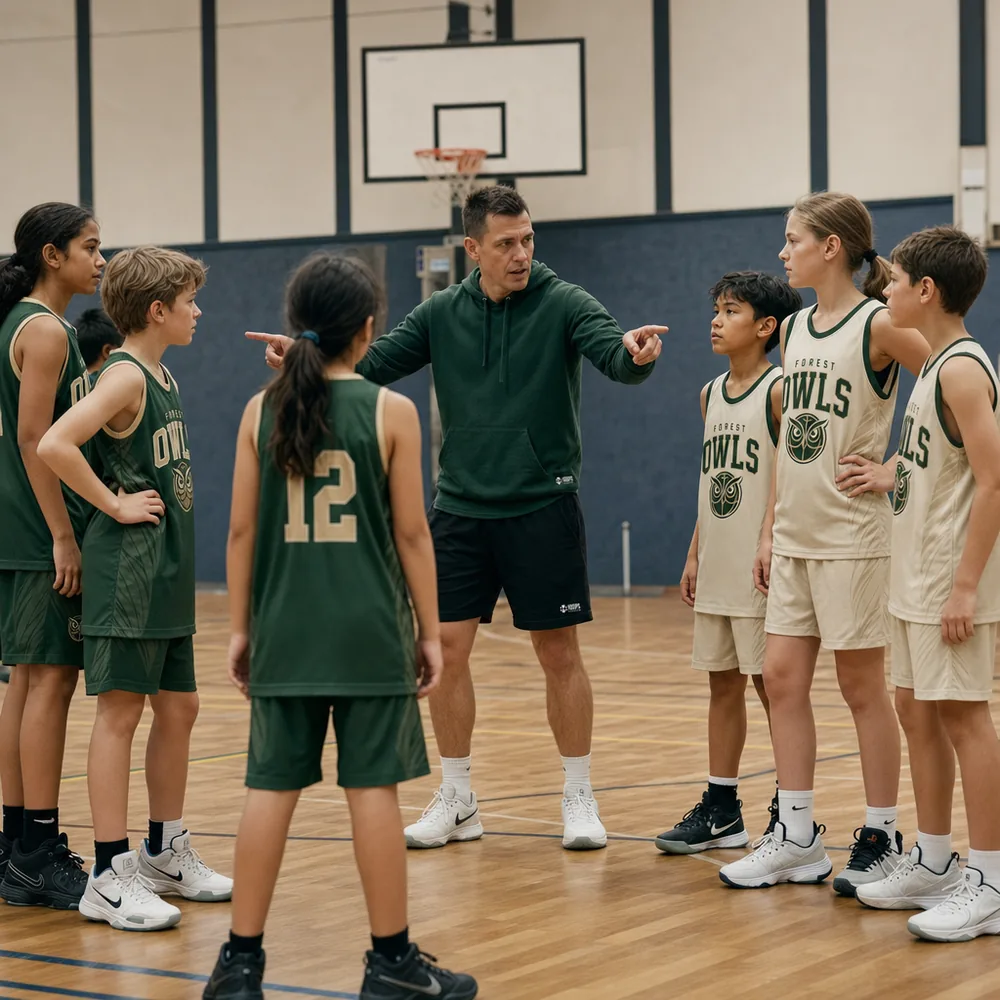
Ages 11 to 13: decisions under pressure
Add defenders and decisions. Players should learn when to pass, dribble or shoot, not just how.
- 3 v 2, 2 v 1. Three attackers against two defenders to one end. The shooter and passer then defend two attackers coming back.
- Shell defence. Four attackers pass around the perimeter. Four defenders move to the right spot with every pass.
- Pass and cut. Pass to a teammate, cut hard to the basket, and receive the return pass for a layup.
- Small-sided games. 3 v 3 half court with a rule, such as three passes before a shot or points only for layups.
Ages 14 and up
Older juniors can handle full-court drills, team plays and conditioning, but games still teach more than drills. Spend at least a third of every session in game situations.
A 60-minute session plan
| Time | Block | Example |
|---|---|---|
| 0–10 min | Warm-up game | Dribble tag or Red light, green light |
| 10–25 min | Skill block 1 | Dribbling or footwork |
| 25–40 min | Skill block 2 | Passing or shooting |
| 40–55 min | Small-sided game | 2 v 2 or 3 v 3 with a skill rule |
| 55–60 min | Cool-down | Free-throw challenge and wrap-up |
Ball sizes and ring heights
A ball that fits the player’s hands makes every skill easier. Australian competitions generally use:
| Age | Ball | Ring |
|---|---|---|
| Prep to grade 2 (Aussie Hoops) | Size 4 | Lower rings |
| Under 12 | Size 5 | Check your association |
| Under 14, and girls’ and women’s teams | Size 6 | Full height (3.05 m) |
| Under 16 boys and older | Size 7 | Full height (3.05 m) |
Ages and sizes vary between associations, so check your competition’s rules.
More drills
- Basketball shooting drills: form shooting, catch-and-shoot and game-speed shooting
- Dribbling and passing drills: ball handling, both hands and passing under pressure
- Basketball positions explained: what each position does
Running a junior program? We kit out clubs from under-8s to seniors, with training reversibles that turn one squad into two teams. See training reversibles or how we work with local clubs.